Reconciliation loop
Modules
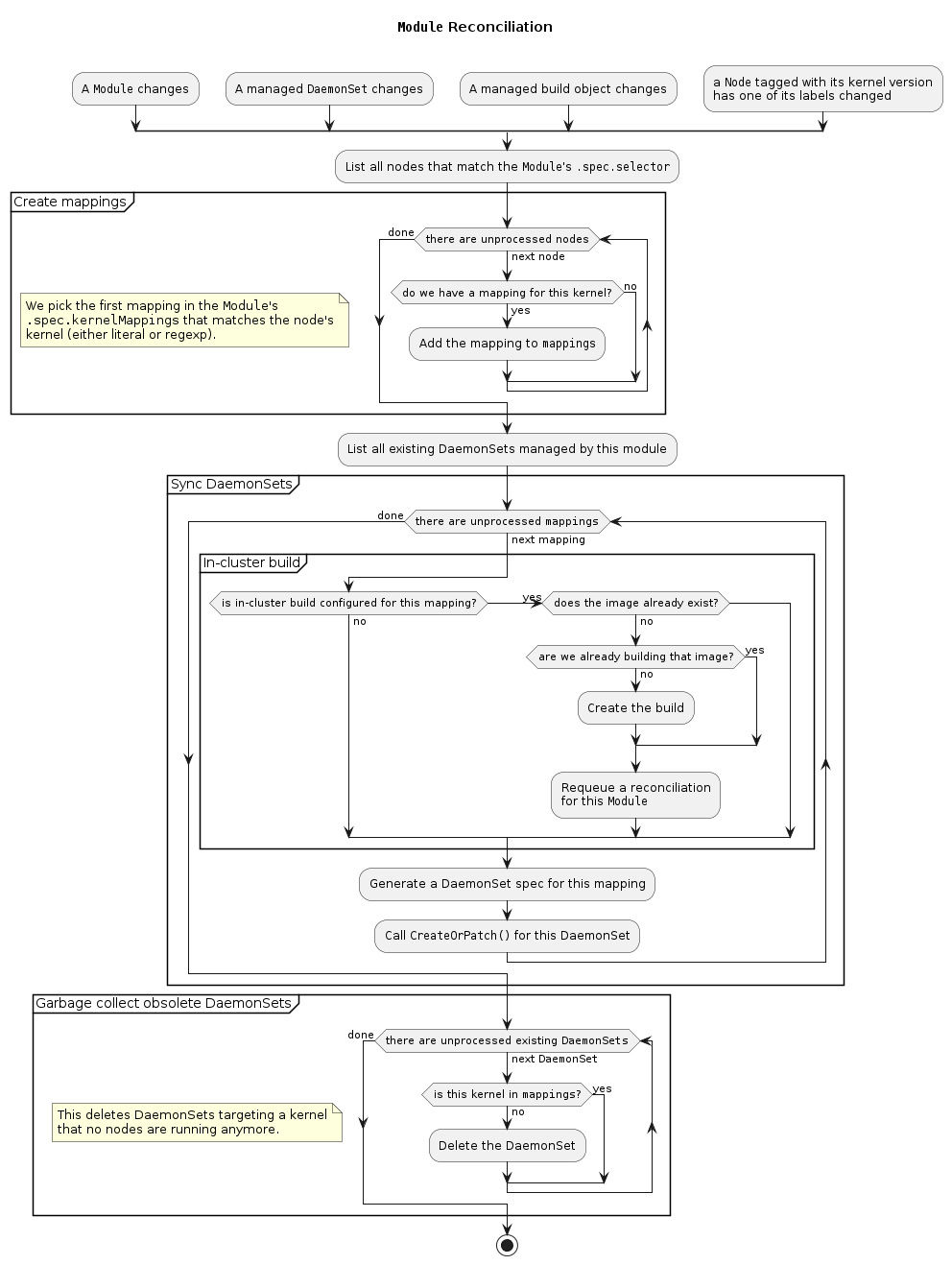
Each time a new Module is created, we need to find to which nodes it applies.
-
A first filtering is performed using the
.spec.selectorfield, then we go through the module’s kernel mappings to find a container image that matches the node’s kernel. -
We end up with a certain number of (kernel, image) pairs; for each of these pairs, there should be a
DaemonSet. -
We first look for a
DaemonSetthat would already be targeting the same kernel and DriverContainer image (that data is stored in theDaemonSet’s labels). -
If there is already such a
DaemonSet, we patch it, if needed. -
If there is not already a matching
DaemonSet, we create it and set theModuleas owner. -
When a
Moduleis deleted, we have nothing to do: because we set it as owner of allDaemonSets, Kubernetes garbage collection will take care of deleting them. -
We watch
Module, ownedDaemonSetand build objects as well as nodes to make sure that we are not missing any change in the cluster.
DRA
A separate DRA reconciler watches Module resources that have .spec.dra set.
-
When a
Modulehas.spec.draconfigured, the DRA reconciler creates a DRA driverDaemonSettargeting nodes where the kernel module is loaded and that carry thekmm.node.kubernetes.io/<namespace>.<modulename>.dra-targetlabel. The reconciler puts that label on every schedulable node theModuleselects and takes it off a node that is no longer schedulable, so the DRA driverDaemonSetis evicted from a draining node. A node that stops matching.spec.selectoris not visited here and keeps the label untilspec.drais removed or theModuleis deleted. AModulewith no.spec.moduleLoaderhas no kernel module to unload, so itsDaemonSettargets.spec.selectordirectly and does not select on the label. -
It also creates and manages cluster-scoped
DeviceClassresources as declared in.spec.dra.deviceClasses. DeviceClasses are tracked via labels (kmm.node.kubernetes.io/module.nameandkmm.node.kubernetes.io/module.namespace) since they are cluster-scoped while Modules are namespaced. -
When
spec.drais removed or theModuleis deleted, the reconciler deletes all associated DRADaemonSetandDeviceClassresources. -
During ordered upgrades, a new DRA
DaemonSetis created for the new module version. Once the old-versionDaemonSetis no longer scheduled on any node, it is garbage-collected. -
We watch
Module, ownedDaemonSet,DeviceClassand nodes, since thedra-targetlabel is decided from a node's own labels and taints.